
Uncategorized
Mushroom Laboratory Equipment That Earns Its Place
Sep
A crowded bench, mystery containers, and improvised storage do not make a serious workspace. Mushroom laboratory equipment should do one job above all else: help you keep legal fungal samples organized, clean, traceable, and handled with care. Whether the focus is culinary species, microscopy, taxonomy, or permitted research, the right setup prevents waste before it starts.
The goal is not to buy every shiny item marketed to hobbyists. It is to build a controlled, practical workspace around the kind of legal mushroom work you actually do. A compact home research corner needs different gear than a classroom, a culinary culture project, or a professional-quality microscopy collection.
Start With the Work, Not the Shopping List
Before choosing equipment, decide what happens at the bench. Are you examining prepared slides? Maintaining legal reference cultures? Labeling and cataloging spore prints? Photographing mushroom features for identification? Each task has its own priorities.
For microscopy and documentation, optical quality, clean slide handling, sample storage, and image capture matter most. For legal culture work involving gourmet or medicinal mushrooms, contamination control and consistent labeling become more important. If your goal is only collecting and displaying specimens, storage conditions and records may matter more than specialized instruments.
This is where many people overspend. They buy a large piece of equipment because it looks professional, then discover that basic organization was the real missing piece. Start with the essential workflow: receive a sample, label it, examine it, document it, store it, and safely dispose of anything that is no longer useful.
Core Mushroom Laboratory Equipment for a Clean Bench
A functional workspace begins with a durable, easy-to-clean surface and dedicated storage. Nonporous trays, small sealed containers, and a clear zone for clean materials reduce the chance that samples, notes, and everyday household clutter end up mixed together.
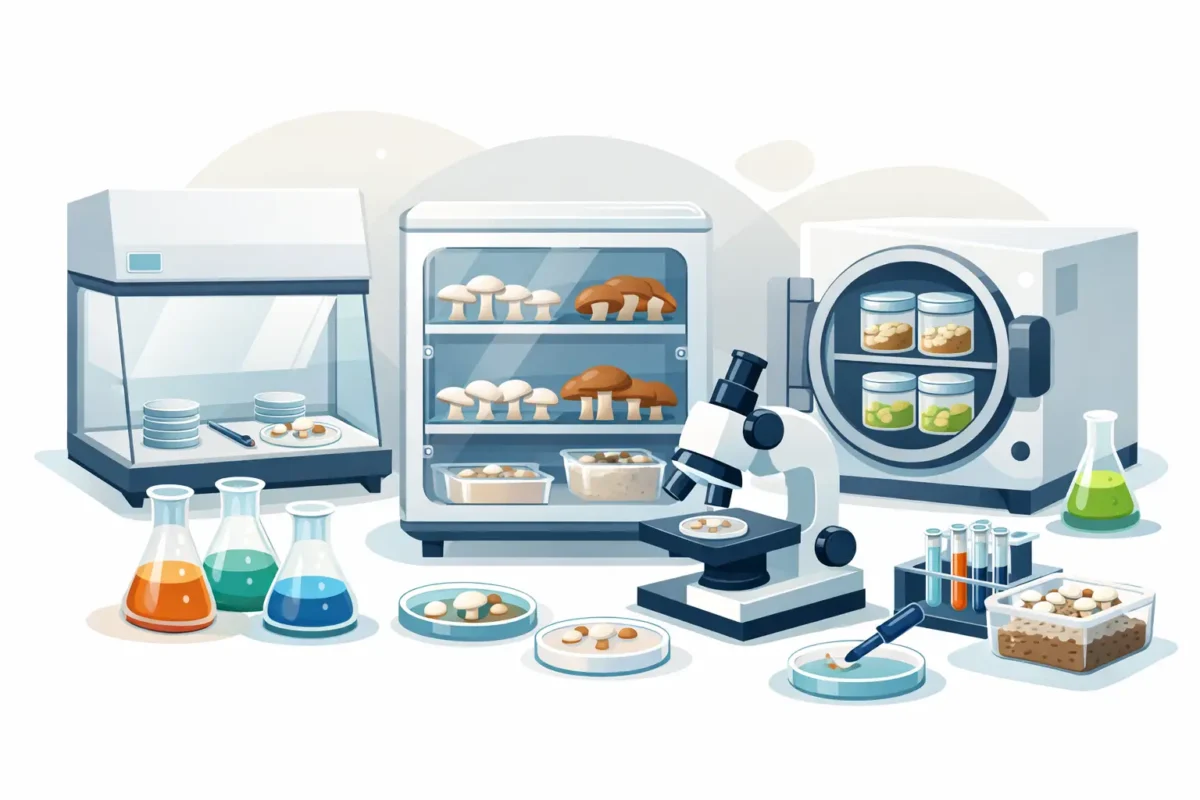
A quality microscope is often the center of mushroom laboratory equipment for identification and educational work. The best choice depends on what you intend to observe. A basic stereomicroscope is useful for surface details and larger structures, while a compound microscope is better suited to fine features on prepared slides. Buying a microscope with poor optics just to get a higher magnification number is a bad trade. Clear optics, stable focus controls, and a reliable light source beat exaggerated specifications.
Glass slides, cover slips, disposable pipettes, forceps, scalpels intended for laboratory use, and sample vials round out a basic examination kit. These are ordinary tools, but they deserve disciplined handling. Keep clean and used tools separate, replace damaged containers, and label every item before it leaves your hand.
Personal protective equipment belongs in the setup too. Disposable gloves, eye protection when appropriate, and a lab coat or dedicated protective layer help keep a work area separate from food, pets, and shared household surfaces. Protective gear is not a substitute for good hygiene, but it reinforces the boundaries that make a workspace easier to manage.
Clean Handling Is More Valuable Than Fancy Gear
No piece of equipment can compensate for sloppy habits. The most useful upgrade may be a clear cleaning routine, a waste container, and a shelf system that stops samples from being stacked in random places.
Use cleaning products according to their labels and allow surfaces to dry fully before placing materials down. Keep food and drinks outside the work zone. Store tools in closed cases or drawers rather than leaving them exposed to dust. These practices are simple, but they protect sample quality and make it easier to spot when something has changed.
For projects that require a more controlled environment, assess the activity carefully before purchasing anything specialized. Equipment marketed for sterile work can be costly, takes up real space, and requires proper use and maintenance. It may make sense for permitted culinary culture projects, but it is unnecessary for every form of mushroom observation or documentation.
There is also a legal line worth keeping clear. Equipment should be used only for lawful activities in your location. Rules around fungal species, spores, cultures, and psychoactive compounds differ sharply by state and jurisdiction. Do not assume that a product description, an online claim, or a familiar name determines what is allowed where you live. Check current local rules before obtaining or handling any material.
Storage, Labels, and Records Make the Setup Real
The difference between a collection and a laboratory is often the paperwork. A sample without a label is just an unknown object waiting to create confusion.
Use water-resistant labels and record the date, source, species name if known, collection or purchase details where lawful, and the purpose of the sample. Add a unique identifier that matches a notebook, spreadsheet, or digital file. If photographs are part of the project, include the identifier in the image file name rather than relying on memory later.
A small digital scale can be useful for lawful specimen documentation or material preparation, but it should be selected for accuracy in the range you need, not for dramatic product claims. Likewise, a thermometer and hygrometer can help monitor a storage area, especially where heat or humidity could damage paper records, dried reference specimens, or other sensitive materials.
For long-term organization, use sealed containers sized to the materials inside. Oversized containers waste space and invite clutter. Containers that are too small can crush delicate specimens or make labeling difficult. Clear boxes are convenient for quick visual checks, while opaque storage can be better for materials that should stay out of direct light. It depends on what you are storing and how often you need access.
Build for Privacy Without Building for Confusion
Privacy matters for many adults who keep personal research materials, but privacy should never mean unlabeled containers or hidden hazards. A lockable cabinet, a dedicated storage tote, and a simple inventory record can provide discretion while keeping materials accessible to the person responsible for them.
Avoid storing laboratory supplies beside medications, kitchen ingredients, or recreational items. This is especially important in shared homes. Clear physical separation reduces accidental mix-ups and makes cleaning routines much easier to enforce.
If children, pets, or visitors are present, the standard needs to be higher. Secure storage is not optional. Keep sharp tools, glassware, cleaning products, and all samples in closed, appropriately stored areas. A serious setup is measured by control, not by how much equipment is visible on a shelf.
What to Skip Until You Have a Real Need
Some purchases sound essential because they appear in every online equipment bundle. That does not make them necessary for your project. Bulk packs of consumables can expire, take up room, or become waste. Oversized storage units create more places for disorganization. Complex instruments may need calibration, replacement parts, and skills that a casual user does not have.
Be skeptical of products that promise laboratory-grade results without describing materials, accuracy, care requirements, or limitations. Good equipment listings explain what an item does, what it does not do, and how it should be maintained. If the claims are loud but the specifications are thin, keep looking.
A smart buying order is usually simple: establish clean storage and labels first, choose the main observation tool second, then add consumables and specialty equipment only after the workflow proves it needs them. This keeps the bench usable instead of turning it into an expensive pile of unopened supplies.
A Setup That Stays Useful
The best mushroom laboratory equipment is not the most dramatic gear in the room. It is the equipment you can clean, store, understand, and use consistently within lawful boundaries. Build a space where every item has a reason to be there, every sample has a record, and every storage decision makes the next session easier. That is how a mushroom workspace earns its place.

